
Transforming Texan communities through composting to foster sustainability, community, and financial gain with HEB
Role/Contribution
Strategy, UX and Visual Designer, Research
Duration
4 Months
Deliverables
Prototype, Brand Identity, Pitch deck & Report
Team
Laura Rengifo
Kailyn Saltzman
Situation
Grocery stores are major contributors to food waste, and the absence of a centralized composting system in Texas further complicates efforts for residents to address the issue effectively.
Approach
Partnering with H-E-B, a well-known Texas grocery store that is committed to ensuring that our state is just as great 100 years from now as it is today through their effort: Our Texas, Our Future, we aim to minimize waste and maximize customer relationships with a new composting program.
Key Results
100+ screens for our prototype to visualize how farmers, customers, and H-E-B work together in our composting program/system.
3 engaging graphics that illustrate what composting is, provide details about our composting program, and promote H-E-B workshops.
90,000 tons of CO2 equivalent greenhouse gases reduced if all of Austin composted their food for an entire year instead of landfilling it.
Problem
Texan cities fail to meet shifting community preferences towards sustainability and community
Growing interest in sustainability is reshaping consumer choices:
-
40% of consumers factor in sustainability in a purchase, so more people are opting for sustainable alternatives like bringing reusable bags.
-
65% of Texas voters support government action to address climate change.
-
67% of non-composters would be willing to if it were more convenient to do so in their community.
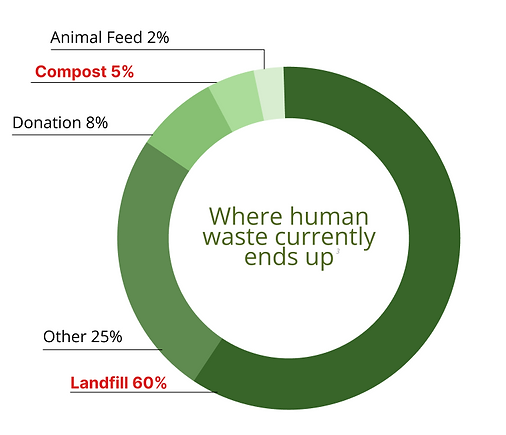
With 28% of landfill waste being compostable,
Texas's no centralized compost system makes it harder for Texans to help make an impact.
Why H-E-B?
H-E-B Puts Texans Above All
Tapped into a powerful consumer base: Texas pride. H-E-B ranks as its state’s #1 grocery store consistently.
No plans to open stores outside of Texas. 340 locations across Texas only.
Commitment to positively impacting its home state. Programs like HEB roots to support Texan farmers, and several disaster relief programs.

Before Research
How can H-E-B profit from creating and sustaining a community?
By linking farmers, stores, and consumers, we can establish a system benefiting all through increased foot traffic, social recognition, savings, and waste reduction.
UX can assist in this process by:
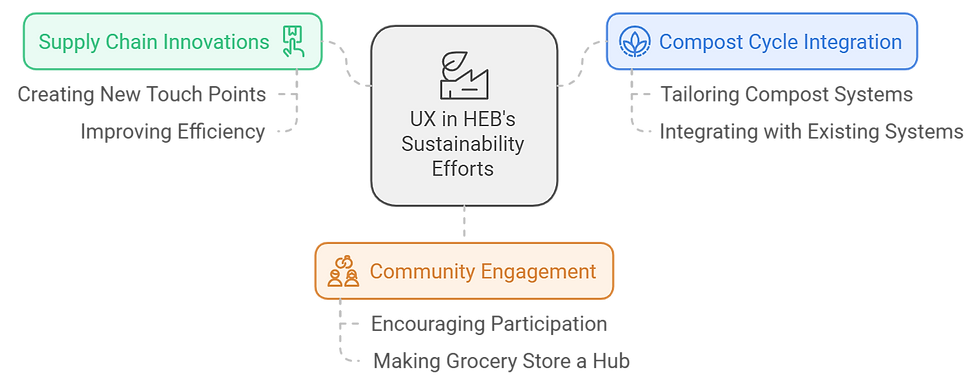
How we guided our project
We began structuring a project timeline to help guide us in our process and ensure that we were moving along at a good pace throughout the semester. Timelines were subject to change as we continued in the process.

Goals of Research
We did a total of 2 preliminary research sprints to kickstart our ideation to answer 3 questions:
-
What are the systems in place and what opportunity is there in the market?
-
What do consumers need and want in a grocery store
-
How can we benefit all 3 major stakeholders

Our research would allow us to gain a greater understanding of the supply chain we were designing for as well as get insights from the consumers who buy the products from it. This feedback is crucial to ensure the design is successful as it relies on consumer participation and interest.
Secondary & Primary Research
What are the systems in place and what opportunity is there in the market?
Consumers are increasingly purchasing directly from farmers for fresher produce and to support local economies. Businesses can stay competitive by updating their operations to be more efficient, community-oriented, and sustainable.
With that in mind, we've identified a market opportunity for H-E-B: composting.

Composting would benefit 3 major stakeholders in this specific chain system
Grocery stores:
-
The composting industry is young but growing.
-
Competing stores have not tapped into the potential of compost.
-
Sending organic waste for compost is less costly than landfill access.
Consumers:
-
70% of consumers will change their spending to attain increased savings and discounts.
-
Consumers highly prefer a personalized experience.
Farmers:
-
The use of compost improves crop production as opposed to synthetic fertilizers.
-
Composting has a variety of benefits for farmers such as improving plant growth and health, soil tilth, microorganisms, increasing root depth, conserving water, and more.
Competitive analysis helped define our value
A competitive analysis helped us determine how HEB will distinguish itself from competitors regarding its sustainability practices and stand out to our target market.
-
Strong competitors like Whole Foods are not engaging or incentivizing their consumers to take action on the resources they provide.
-
Strong competitors are often more expensive.
-
Walmart, a cheaper alternative, does not aim to provide superior services.
.jpg)
What do HEB shoppers know, need, and want?
33 surveys and 5 interviews gave us the insights we needed to understand the common HEB shopper.

None of our survey respondents were aware of sustainability practices at their grocery stores.

83% of respondents find the ability to earn points or discounts incentivizing. 53% of respondents said they use coupons while shopping.

Customers do not want to change their routines by much. “I would love to be more sustainable, but it takes too much effort.”

76% of respondents want to see more information and education within stores about the importance of conservation efforts.
Our secondary and primary research told us our solution must be:
.png)
Ideation
How do we integrate composting into a supply chain?
System mapping:
Collaboratively drawing out our system helped us to understand how our system works and what deliverables to create to best represent it.

1. Rough Structure
2. Exploring relationships
3. Brain dumping and expanding on ideas
A digital, color-coded map visually represented 3 stakeholders' touchpoints, pink: customers, blue: grocery store, and green: farmers. Blended colors show the areas where the stakeholders interact or collaborate.

Analyzing our stakeholders
After creating our map of 3 major stakeholders, we took a look at more sub-stakeholders aside from them who would be affected and brainstormed how we could better cater to their needs to give them a positive impact as well.
This helped us to determine which deliverables would be best to create during our project.

The touch-points in our system that
we decided to tackle

We solidified what parts of the supply chain we were tackling with ideas we sketched.
Ideas were selected taking into account how well they work together as a system if they account for all 3 major stakeholders and sub-stakeholders, as well as how feasible they were to complete within a certain time frame given that we needed 3 main deliverables.
Our focus for our prototype was connecting customers with HEB farmers through the new composting system.
Card-sorting with users guided our IA creation.
We asked that they group the cards in a way that made sense to them and then explain.

Card-sorting concepts from brain dump by users.
With their help, we created two IA’s to help us map out our farmer UI and customer UI


The Solution
Welcome to the HE-Green Program, connecting Texan communities through food by involving customers in the journey from farm to plate and linking growers with buyers with HEB's existing mobile app.

Overview of the HE-Green system
Our system consists of 3 major stakeholders:
-
HEB
-
Farmers
-
Customers
HEB links farmers and buyers by managing a compost program where; customers compost, return compost to HEB, and then earn rewards. Compost is then supplied to farmers for crop growth, farmers send a thank you message to customers, then crops are returned to the store. Workshops in-store were also created for learning.
All features would be accessable through the HEB app.

New in-store features offer more ways to learn

For the in-store portion, we wanted to have the experiences for both adults and children to be engaging.
-
We would offer workshops, where participants will get a worksheet, a hands-on DIY compost maker, and another worksheet to take home.
-
Posters that advertise the workshop and explain the do’s and don’ts of composting would be seen around the store, mainly near the entrances and exits, as well as above the area where compost bins are placed.
-
With those compost bins, we have a pamphlet made to take home. It explains the components of the compost bin, the way the compost bin works, a minimized version of the do's and don’ts poster, and how our composting program works.

Examples of worksheets
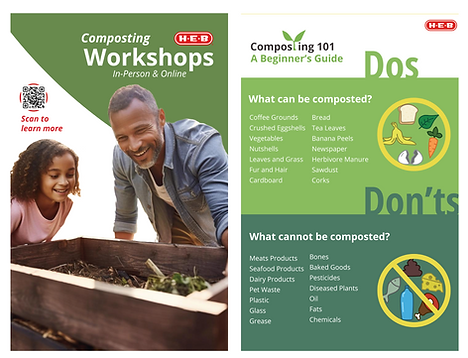
Posters
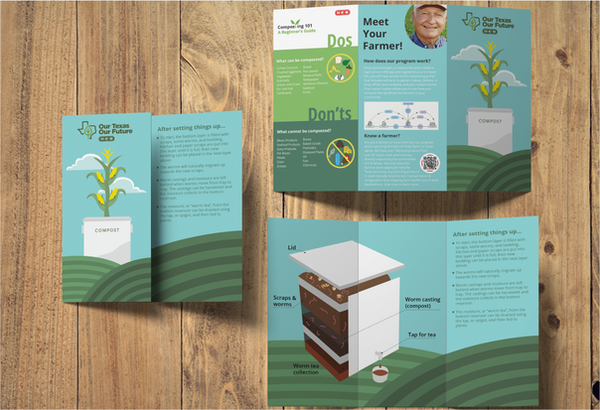
Take home pamphlet attached to compost bin
Farmer UI connects them to HEB and customers
The farmer section easily onboards them and introduces them to features like a portal for farmers to track compost and other things, as well as communicate with HEB.

-
Farmers get a code to access and easily create an account and log in
-
Portal for farmers to track compost
-
Communicate with HEB with ease
-
Another access point and login option for farmers

-
Desktop version of farmer interface
-
Supplier IDM and SSO applications
-
Communicate with HEB associates
-
Get answers to any questions quickly and easily
Customer UI makes onboarding, bin connection, rewards, & communication easy

Customers start with a brief
5-screen introduction, then grant location access to find the nearest H-E-B store. A list of nearby locations appears, and they are subsequently directed to the compost portal homepage.

The user is seamlessly paired with a compost bin through a picture scan
in-person or at home with online registration where bins can be delivered or picked up curbside.

Every time a customer drops off their compost or gets it picked up from their home, they earn points that are added to their rewards profile, which they can use later in the store.

Data gathered from the user's composting progress creates a personalized impact report in the style of an animated story and simple report style.

User's have tons of information on composting through the HEB app and also can sign-up for in person or online workshops.

Compost drop-off made easy, with one scan customers can drop their compost at curbside and collect their points.
Project Results
Our composting program with HEB would increase both customer loyalty and sustainability in Texas cities
100+ screens for our prototype to visualize how farmers, customers, and H-E-B work together in our composting program/system.
3 engaging graphics that illustrate what composting is, provide details about our composting program, and promote H-E-B workshops.
90,000 tons of CO2 equivalent greenhouse gases reduced if all of Austin composted their food for an entire year instead of landfilling it.
Next steps:
-
Composter prototype
-
Story-boards
-
Reach out to HEB corporate
-
Interview Texan farmers
-
Price estimate about implementation
-
Expand on each section of the map
My takeaways:
My team and I's research resulted in a sustainable program for a
well-known Texan grocery chain. This project gave me a better understanding of how chain systems work and how parts of them work together to create a balance. I also had a lot of fun seeing my designs for the pamphlet come to life and drawing out systems, didn't realize everything that went into chain systems.